The Whole Spice Cabinet
blended, roasted, and freeze-dried into a single packet.
A proper curry masala requires a dozen spices in precise ratios. Rasoi does the sourcing, the toasting, and the blending — just dissolve in warm water and your curry starts where the interesting part begins, not at the spice rack.
What is actually in the cube
Thirteen real ingredients. One cube.
Sourced, roasted, and blended — the whole spice cabinet in a pouch.
13 real ingredients
Dissolve in warm water and stir directly into your curry.
What is not in it
Clean label. Every time.
- Preservatives
- Added sugars
- MSG or flavor enhancers
- Fillers or anti-caking agents
- Artificial colors or flavors
- Gluten or dairy
How It Works
Two ways to use it.
Make a paste, or add straight to the pan.
- 1Add cube to a bowl
Drop the whole cube into a small bowl.
- 2Pour 2–3 tbsp of warm water
Just enough to cover the cube.
- 3Cover and wait 60 seconds
Let the cube absorb the water and soften.
- 4Mix until lumps dissolve
Stir with a spoon until smooth and uniform.
- 5Pour over your dish or into a pan
Add the paste on top of a prepared dish to mix in, or add it to a pan to start cooking from scratch.
- 1Add cube to warm water in a pan
Drop the whole cube into 1/4 cup of warm water in a pan. Let it dissolve.
- 2Add your dish
Add rice, protein, pasta, vegetables — whatever you are cooking.
- 3Mix and enjoy
Stir everything together. The flavor distributes evenly as it cooks.
The Golden Ratio
1 cube · 1 cup
1 cube per 1 cup of food or liquid. Scale up for bigger portions.
Where to Use It
Your go-to for rich, spiced curries.
From bean curries to chicken to flatbread pairings — one cube does it all.
Rajma & Chhole
Simmer with kidney beans or chickpeas for a rich, spiced North Indian curry — a classic pairing.
Chicken & Paneer Curries
Add one cube while cooking chicken, paneer, or vegetables for deep, home-style flavor.
Flatbreads & Wraps
Spread inside a wrap, or serve alongside naan and roti for dipping.
Marinades
Mix with yogurt, oil, or lemon juice to marinate meats, seafood, or tofu.
Why Freeze-Dried
Real ingredients, paused at peak.
Conventional drying uses high heat. It strips out flavor, aroma, and much of what made the ingredient worth using in the first place.
Freeze-drying works differently. Ingredients are flash-frozen at their freshest, then the water is drawn out at low temperature — leaving color, aroma, and nutrients largely intact. When the cube meets moisture again, everything wakes back up.
Questions, answered
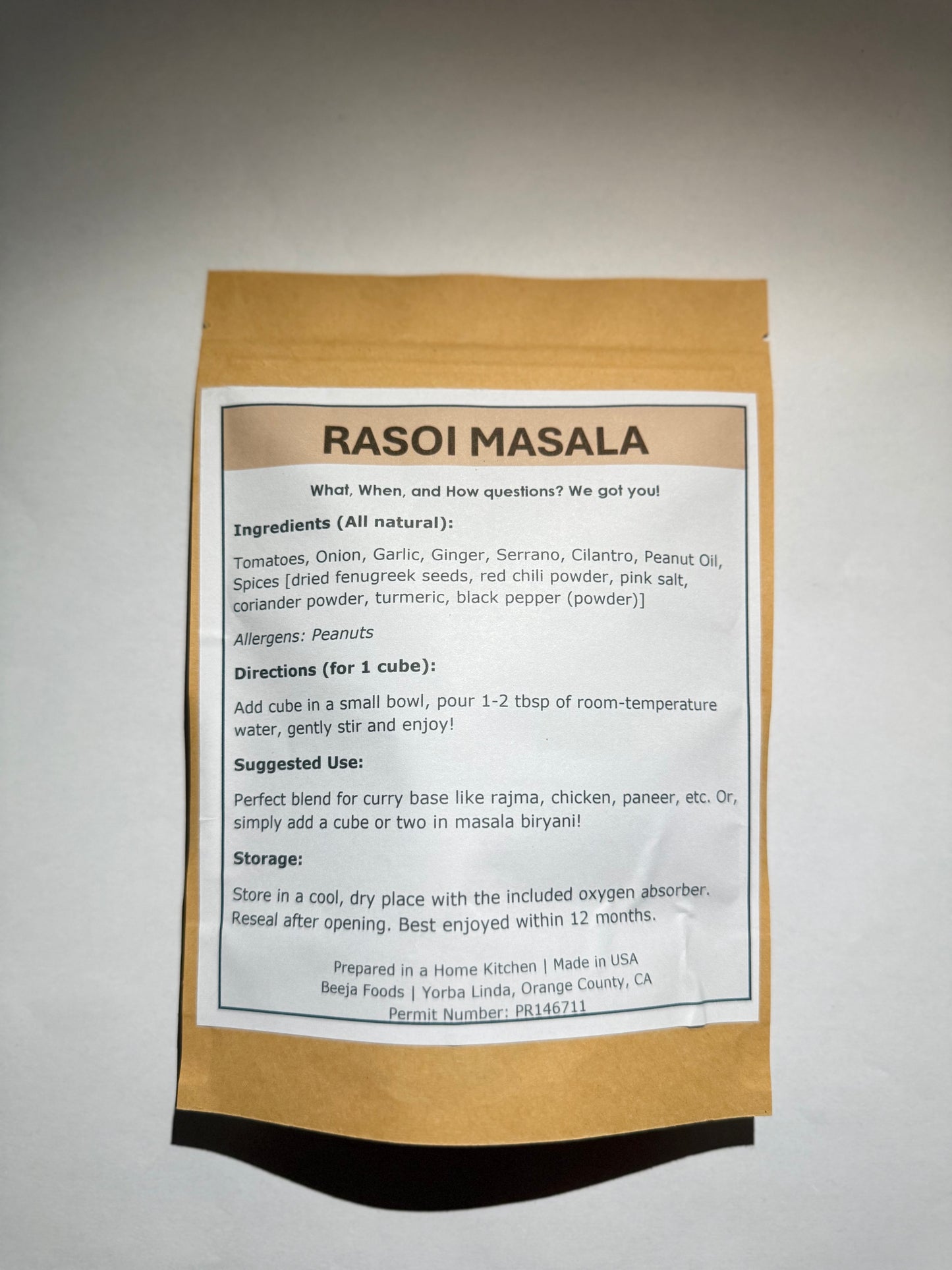
Yes. Rasoi Curry Masala contains peanut oil. It is not suitable for anyone with a peanut or tree nut allergy. Please check the full ingredient label before purchasing if this applies to you.
Tomatoes, onion, garlic, ginger, serrano, cilantro, peanut oil, dried fenugreek seeds, red chili powder, pink salt, coriander powder, turmeric, and black pepper powder. 13 real ingredients.
6 cubes per pouch.
Warm water. You can make a paste with 2–3 tablespoons, or add the cube straight into a pan with 1/4 cup of warm water.
Room temperature, resealed after each use. Keep the included oxygen absorber packet inside the pouch — it prevents moisture from getting in and keeps the cubes crisp. No refrigeration needed. Shelf life is 12 months from the date of manufacture.
Both start with tomatoes, onion, garlic, and ginger, but they are built for different jobs. Rasoi is a robust, all-purpose curry masala, earthy and spiced with coriander, dried fenugreek, and red chili — the one to reach for simmering bean curries like rajma and chhole, or chicken and paneer, and it works just as well folded into a wrap or scooped up with flatbread. Tikka Masala is warmer and more aromatic — cardamom, clove, cinnamon, and fennel — built specifically for a smooth, restaurant-style tomato sauce, often finished with butter or cream. One more difference worth knowing: Rasoi contains peanut oil, Tikka Masala does not.